Does Your Fragrance Factory Actually Export? Reading Market Reach Honestly
Export experience is one of the most valuable things a fragrance manufacturer can offer a brand — and one of the easiest claims to state loosely. The honest test is not how many countries a factory says it serves, but whether it can produce the document pack, label adaptations and customs paperwork your specific market needs. That test is concrete, and this article explains how to run it.
Key takeaways
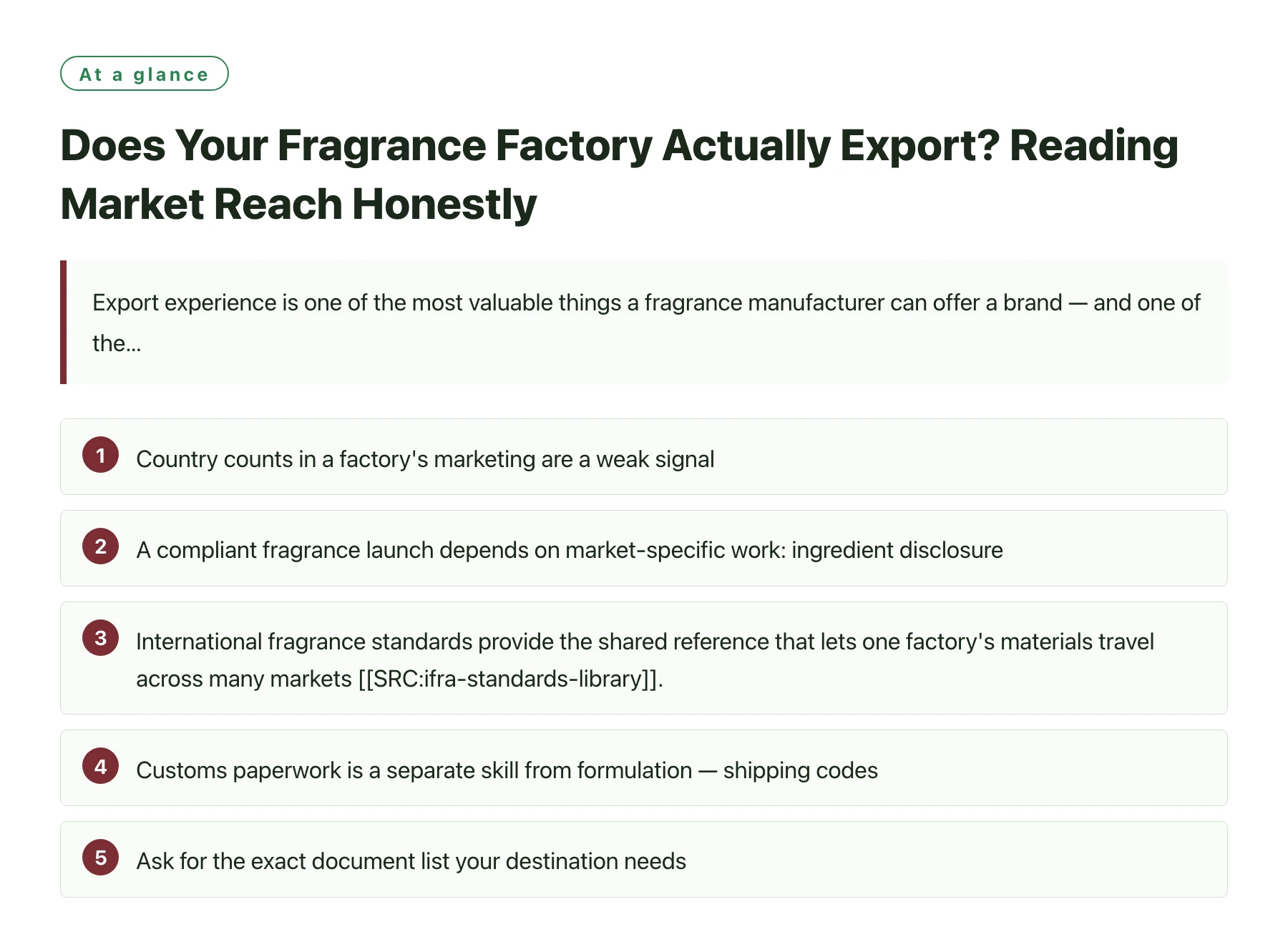
- Country counts in a factory's marketing are a weak signal; what counts is whether the factory holds ready document packs for the markets that matter to you.
- A compliant fragrance launch depends on market-specific work: ingredient disclosure, allergen labelling, safety assessment and notifications [1].
- International fragrance standards provide the shared reference that lets one factory's materials travel across many markets [2].
- Customs paperwork is a separate skill from formulation — shipping codes, certificates of origin and restricted-material declarations can stop a pallet at the border.
- Ask for the exact document list your destination needs, and compare the factory's answer against an independent source.
'We export to 100+ countries' — phrases like this appear on almost every Chinese fragrance manufacturer's website, often as a company-stated figure. It tells you something about ambition and volume. It tells you almost nothing about whether your particular market will be easy or painful.
Export experience is a bundle of specific capabilities: market-specific documentation, labelling rules, customs readiness, and the people who handle them. Here is how to test the bundle instead of the slogan.
What export experience is actually made of
Export experience is not one skill. It is four. The first is regulatory knowledge: knowing that the EU requires a responsible person, a safety assessment and ingredient disclosure, while other markets insist on their own notifications and labelling formats [1]. The second is documentation: having the templates, translations and certificates ready, not improvising them per order. The third is customs and logistics: correct shipping codes, certificates of origin, restricted-material declarations and pallet paperwork that actually gets a load across a border. The fourth is language: being able to discuss all of the above in the buyer's language, which is rarer than it sounds.
A factory with real export experience will ask you where you are shipping to before it quotes — and will adjust the quotation to the documentation that market requires. A factory selling 'worldwide' without a follow-up question is selling a phrase.
Industry standards give exporters a common language: international fragrance practice documents how materials are assessed and used safely, which is why a factory's products can be sold in many markets from the same base [2]. The standard does the heavy lifting; the factory still has to apply it per destination.
How to test the document pack
Pick your destination, write a short product description, and ask the factory for the exact document list that order will need — tests, certificates, declarations, translations. Then check their list against a reputable independent source for that market. The gaps between the two lists are the price of inexperience, and they are free to discover before you commit.
Also ask who prepares the pack. A dedicated export or compliance person is a good sign; 'we ask the lab' can mean the documents arrive late and slightly wrong.
The export pack your factory should know
| For market type | Typical documents | Where experience shows |
|---|---|---|
| European Union | Safety assessment, product information file, ingredient and allergen disclosure | Knowing that compliance is the importer or responsible person's duty too [1] |
| North America | Ingredient declaration, allergen statement, market-specific notification | Handling labelling claims without over-promising |
| Middle East | Halal documentation where required, Arabic labelling | Producing fitting documents without drama |
| Other regions | Customs codes, certificates of origin, restricted-material declarations | Shipping the pallet without border surprises |
The right reaction to this table is not 'the factory will handle everything'. It is 'the factory should know what this table contains for my market'. Export experience is a shared responsibility with clear edges, not a black box.
Reading a manufacturer's market claims
When a manufacturer reports serving a large number of brands and countries — as many Guangzhou fragrance houses do in their company figures — treat the number as context, then verify the specifics: which markets, which document packs, which languages. The brands behind the scents and the examples a factory shows are evidence of breadth brands Xuelei has manufactured for can be read as an indicator of how much variety the plant sees, though customer names and project specifics usually stay confidential.
The broader question of how how Chinese perfumery reaches global shelves is worth understanding even independently of any one supplier, because it tells you which parts of the route are the factory's responsibility and which are yours.
A Guangzhou house like Guangzhou Xuelei that states it has served four hundred-plus brands across a hundred-plus countries, on top of three decades of manufacturing, has plausible reasons for that claim — export volume, document habit and client variety tend to accumulate together. Plausibility is not proof, so check the document pack for your own market and let the answers set your confidence level.
The single most useful export question: 'Show me the complete document pack you would send with a first container to my market.' If the factory can lay it out on the spot — with tests, certificates and translations — export experience is real. If the answer is 'we will prepare it later', you have just found the biggest risk in the project.
Sources
- European Commission: Cosmetics in the EU —— The European Commission's overview of EU cosmetics rules, including the responsible person, product information file and safety report requirements.
- IFRA Standards Library (International Fragrance Association) —— The IFRA Standards Library lists the restrictions the fragrance industry applies to individual fragrance ingredients, based on safety assessments; it is the reference point for compliant fragrance formulation.
Frequently asked questions
How many markets should a fragrance manufacturer serve before I trust the export claim?
The number matters less than the match: one factory serving five markets you care about is more useful than one serving a hundred you do not. Ask specifically about your destination.
What export documents should a first order include?
At minimum the market's compliance documents (safety assessment, ingredient disclosure, notifications where required), plus commercial paperwork — invoice, packing list, certificate of origin and the shipping documents your forwarder names.
Should I rely on the factory or hire a compliance expert?
Both. The factory should produce and stand behind the technical documents; an independent expert (or your own research) should confirm the list matches your market's rules. Export is a shared responsibility, not a handover.
Can a factory with no export history still make a good product?
Yes, but the first export order will teach you lessons together, and you will carry the documentation risk. For a first launch, a factory with an existing export habit is usually the lower-risk choice.
How do customs delays happen with fragrance shipments?
Usually through misclassified shipping codes, missing restricted-material declarations or incomplete origin paperwork. A factory that ships fragrance regularly has these down to routine; one that does not will discover them on your container.