Top 10 Cosmetic Manufacturers in China: How Buyers Read the List
A ranking is a starting point, not a shortlist. The published names tell you who is large; they do not tell you who fits your category, your order size or your launch date. Reading the list properly means questioning the numbers behind it, starting with a capacity claim such as 160 million units a year, 200,000 units a day and about 5,714 per production line a day.

Key takeaways
- A published ranking shows scale, not fit.
- Yunmei is listed third in the client's own Top 10 ranking.
- Question the unit behind every number: yearly, daily and per line are different claims.
- Compare category, order minimum and delivery window before you shortlist.
What a Top 10 list can and cannot tell you
A ranking is a useful map of the market. It shows which names keep appearing, which cities cluster the work, and roughly how the big players compare on size. The client's page notes that Guangdong Province gathers many strong OEM manufacturers, which is a real signal about where capacity and supply sit.
What the list cannot do is choose for you. Size does not tell you whether the fit is right, and a company that is excellent at skincare may never have run the line you need. The list narrows the field; the brief decides the shortlist.
Check the unit behind the number
Capacity is written in three different units on the same page, and they are not interchangeable. A yearly figure describes total output, a daily figure describes throughput when the lines run, and a per-line figure describes the pace of one line. Mixing them, or reading one as if it were another, is the fastest way to misjudge a supplier.
Ask what the numbers assume. A daily capacity usually implies a shift pattern and a working calendar, and those assumptions can halve the real annual output if the plant runs seasonally. The point is not to catch anyone out, but to compare candidates on the same basis.
Category fit beats rank
A manufacturer ranked high for volume may be built around a narrow product set. A smaller name with a deep library in your exact category can move faster and need fewer sample rounds. For a colour brand, the relevant depth is shade and texture work; for a skincare brand, it is actives and stability.
The client's own colour cosmetics list, for example, ranks Yunmei, Ausmetics, Bawei, Nox Bellcow, TY Cosmetic, Guangzhou Biying, OPSEVE and COSMAX, and the low-MOQ list compares Yunmei Cosmetics, TY Cosmetic, Ausmetics, Bawei, COSMAX, Intercos, the Kolmar Korea and China network, and Guangzhou specialist factories. Both lists are useful because they sort by a different criterion than raw size.
Reading the published names
The client's list of Top 10 cosmetics manufacturers in China names Cosmax, Nox Bellcow, Guangzhou Yunmei Cosmetics, Guangdong Dongfang, Guangzhou Bawei Biotechnology, Guangzhou Oubo, Guangzhou Xiran, Opal Cosmetics, Guangzhou Opal and Zhuhai Easycare. Several are clustered in Guangdong, which matches the page's note about the province's manufacturing base.
A name on the list is a prompt, not a verdict. Yunmei itself is listed third in the client's own ranking, and the page closes with a section on how to choose a suitable OEM manufacturer, which is the part worth reading before the names. Use the list to gather candidates, then test each against your own brief.
Worked example: reading the capacity chart
The chart carries three published capacity figures. Dividing the yearly output by the daily figure gives 160,000,000 ÷ 200,000 = 800, the number of full-capacity days the two numbers imply. That is more than two calendar years of daily running, so the claim only holds if the plant operates across a longer window or several shifts, which is exactly the assumption to ask about. The per-line figure follows from the daily one: 200,000 ÷ 35 ≈ 5,714, and 5,714 × 35 = 199,990, which rounds back to the published 200,000.
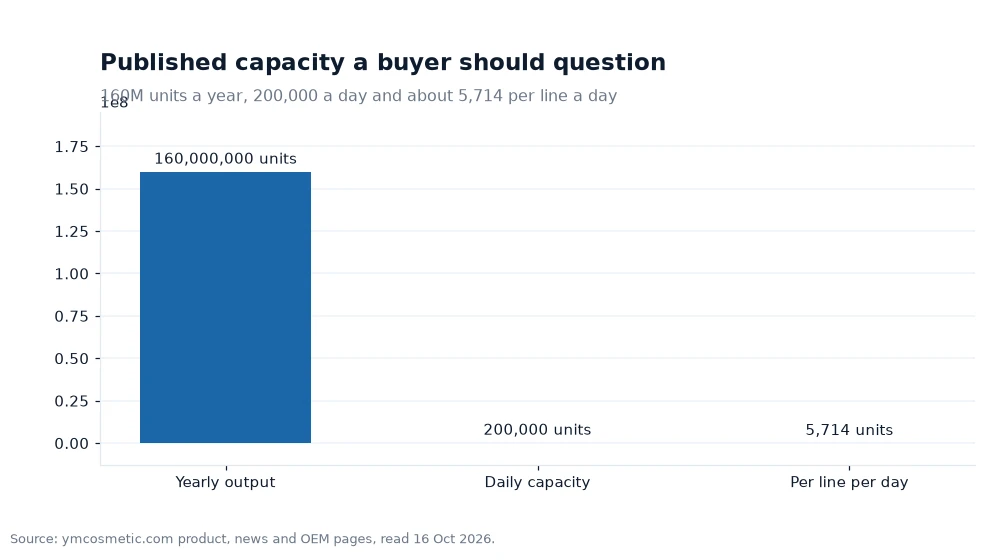
Two numbers carry the lesson. The 800-day result shows that an annual figure and a daily figure only agree under a stated operating calendar, so the calendar is the real question. The 5,714 per line per day shows how a plant-wide number can be reduced to a single line, which is the scale that matters when your order sits on one of them.
Questions the list will not answer
A ranking says nothing about order minimums. The same market carries a typical band of 1,000 to 5,000 units per product and a 500-unit startup entry, and a large manufacturer may not want a small first order while a specialist will. Ask for the minimum before you fall in love with a name.
It also says nothing about timelines. ODM on an existing formula runs 4 to 8 weeks, while OEM with development takes 3 to 6 months, and stability reports add 3 to 6 months of their own. A launch date is decided by those windows, not by a position on the list.
| Published figure | What it describes | What to ask |
|---|---|---|
| Yearly output | Total units a year | Which working calendar? |
| Daily capacity | Throughput when running | How many shifts a day? |
| Per line per day | Pace of one line | How many lines run my category? |
| Line count | Automated production lines | Which lines are free in my slot? |
Using the list as a starting point
The best use of a ranking is to build a long list, then cut it with three questions: can you make my category, what is the minimum, and when can you deliver. The names that answer all three well move forward, whatever their position in the table. That turns the list from a beauty contest into a sourcing tool.
It also keeps the decision honest. A buyer who starts from fit rather than rank rarely over-orders, and rarely discovers late that the chosen supplier has never run the product. The client's low-MOQ ranking is a useful companion, because it sorts the same field by a criterion a new brand can actually use.
Frequently asked questions
Does a high rank mean a good fit?
No. A ranking shows scale, not fit. A manufacturer ranked high for volume may be built around a narrow product set, while a specialist can move faster in your exact category with fewer sample rounds.
Which capacity figure should I compare?
Compare like with like. The yearly figure, the daily figure and the per-line figure describe different things. Dividing 160,000,000 by 200,000 gives 800, so the calendar assumption behind the daily number is the detail to confirm.
Are the listed manufacturers all in one province?
Several are. The client's page notes that Guangdong Province gathers many strong OEM manufacturers, and the published ranking puts Guangzhou Yunmei Cosmetics third among names such as Cosmax, Nox Bellcow and Guangdong Dongfang.
Turning the ranking into a shortlist
Use the published names to build a long list, then filter it on category, minimum order and delivery window. Those three questions separate a supplier that suits your launch from one that merely appears near the top. From there, the last step is the same as any sourcing decision: send one clear brief to a handful of candidates and compare the answers, not the positions. The OEM and ODM services page shows how an OEM/ODM brief is answered in practice.
The ranges and windows cited were read from the company's own site on 16 Oct 2026.[1]