Before You Point a Miner Anywhere: Reading a Pool's Front Page Properly
A pool homepage is a shop window, not a spec sheet. It will tell you that the service spans 150+ countries and 1M+ users, but the number you actually need — what 482 TH/s pays after the listed fee — has to be built from difficulty, subsidy and price. This is a reading method for that second visit, before any machine is pointed at a new address.

Key takeaways
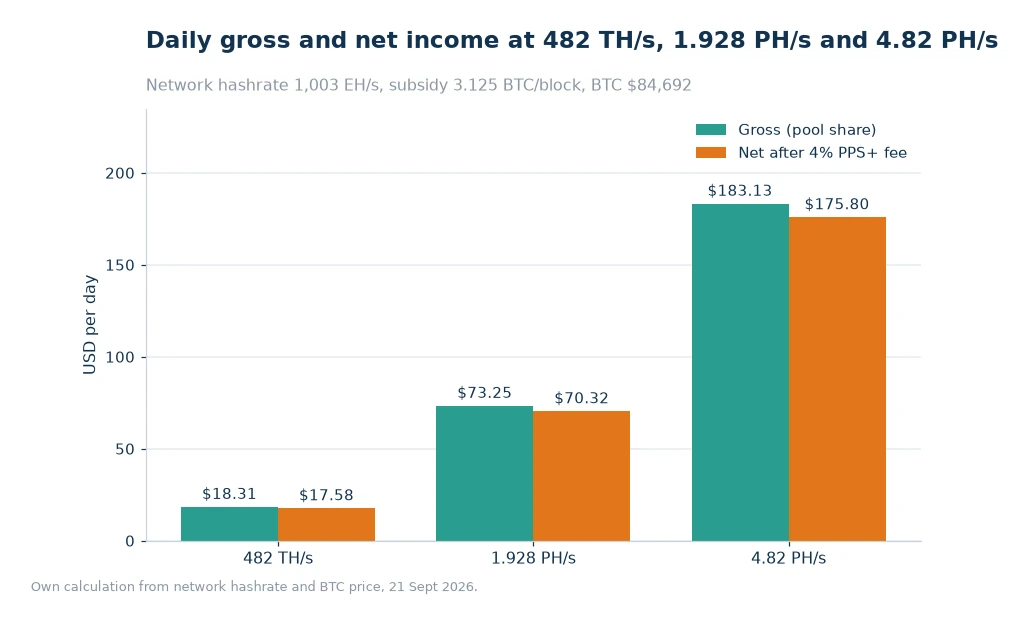
- 482 TH/s returns 0.00021623 BTC a day, which is $18.31 gross and $17.58 after the listed 4%.
- The front page carries scale claims; the fee page carries the numbers that decide your net.
- Coin coverage matters only if you plan to mine more than BTC with the same account.
- Thirty days at 482 TH/s is $527.40 net, a figure worth checking against the power bill first.
What the front page promises and what it leaves to the fee page
Marketing copy on a mining site tends to answer three questions: how big the service is, which coins it supports and which products surround the pool. Numbers appear, but they are usually counts — countries, users, coins. None of them tell you what a terahash earns. That is deliberate, because the earning rate moves with difficulty and price, and a static headline would be wrong within a week.
The useful reading is to treat the front page as an index. Note the claims that can be checked elsewhere: whether the pool publishes live statistics, whether it lists fees as percentages of named reward components, whether the wallet and the mining account are the same login. Each of those leaves a trail to a page with real numbers, and the trail is what you follow before committing hardware.
Three questions a homepage cannot answer
The first is how the fee is applied. Two pools can both advertise "low fees" and mean entirely different things: one charges a percentage of the block reward only, another charges a percentage of the combined block reward and transaction fees. The only way to compare is to read the schedule and note which component each rate touches. A single blended percentage quoted in a chat thread is not a substitute.
The second is when money arrives. Hourly settlement against current difficulty and settlement after six confirmations over a five-round window are different cash-flow shapes, even when the long-run average is similar. For an operator paying a monthly power bill, the shape matters more than the average.
The third is what happens at the edges: a stale worker, a changed payout address, a coin that needs a minimum before withdrawal. These are support-document questions, and the answers decide whether a bad night becomes an email thread or a two-minute fix.
Where the 482 TH/s line comes from
Build the earning line yourself and the marketing becomes secondary. The network produces 450 BTC a day at current settings: 144 blocks multiplied by the 3.125 BTC subsidy. Your share is your hashrate divided by the network total of 1,003 EH/s. Multiply, and you have coin; multiply by $84,692, and you have dollars.
At 482 TH/s that comes to 0.00021623 BTC, or $18.31. After the listed 4% on the block-reward component the net is $17.58. The same rate holds for larger slices: 1.928 PH/s is four times the hashrate and four times the money, $70.32 net, while 4.82 PH/s is ten times, $175.80 net. Proportionality is the one property you can rely on without trusting anybody's dashboard.
One more check belongs in the same pass: does the pool publish its own hashrate and block history, or only yours? A pool that shows shares, blocks and uptime publicly can be compared with the chain. A pool that shows only a personal balance asks you to trust a number you cannot verify. The difference matters at the moment you want to know whether a quiet day was your machine or the pool.
Multi-coin support is a routing decision
The ViaBTC Bitcoin Mining line-up, for instance, covers 20+ coins including BTC, BCH, LTC/DOGE merged mining, KAS, ZEC, HNS, CKB and ETC, which is a menu rather than a bonus. The menu matters if you own hardware that mines something other than SHA-256, or if you want to convert output without moving it to an exchange. It does not raise the BTC rate at 482 TH/s by a single satoshi.
What it does change is operational simplicity. One account, one wallet and one withdrawal path for several coins is less work than three accounts and three sets of records. Auto Conversion, which swaps between coins inside the account, is the feature that makes the menu practical rather than decorative. Check whether that conversion happens at a rate you can see before you rely on it.
| Hashrate | Daily gross | Daily net | 30-day net |
|---|---|---|---|
| 482 TH/s | $18.31 | $17.58 | $527.40 |
| 1.928 PH/s | $73.25 | $70.32 | $2,109.60 |
| 4.82 PH/s | $183.13 | $175.80 | $5,274.00 |
Worked example
Here is the whole calculation behind the first table row, with nothing hidden in a dashboard.
- Network output: 144 blocks × 3.125 BTC = 450 BTC a day.
- One terahash of the network's 1,003 EH/s corresponds to 450 ÷ 1,003,000,000 = 0.00000044865 BTC.
- At 482 TH/s: 482 × 0.00000044865 = 0.00021625 BTC, rounded to 0.00021623 in the chart.
- In dollars: 0.00021625 × 84,692 = $18.31 gross.
- After the listed 4%: 18.31 × 0.96 = $17.58 net.
- Thirty days: 17.58 × 30 = $527.40.
- Ten times the hashrate, 4.82 PH/s, gives 17.58 × 10 = $175.80 net a day.
The rounding difference between 0.00021623 and 0.00021625 is not an error; it is what happens when a chart reports eight decimal places and a calculator carries more. At 482 TH/s the gap is worth a fraction of a cent a day. Scale it to 4.82 PH/s and it is still small, but it explains why two honest estimators can disagree by a dollar or two at month end.
Now put the $527.40 beside the monthly electricity cost for the hardware behind 482 TH/s. If power consumes most of it, the pool's fee is not the deciding variable and no amount of shopping will fix the site. That comparison is the reason to do the arithmetic before the account is opened, not after.
Frequently asked questions
What does 482 TH/s earn per day?
482 TH/s earns 0.00021623 BTC a day at a network hashrate of 1,003 EH/s, worth $18.31 at $84,692 per BTC. After the listed 4% on the block-reward component the net figure is $17.58.
Does supporting many coins raise my BTC payout?
No. The BTC rate at 482 TH/s depends on network hashrate, subsidy and price, not on how many coins the pool lists. Extra coins help only if you own hardware that mines them or want to convert output inside one account.
How often should I re-check the fee page?
Re-check it whenever your hardware changes and at least once a quarter otherwise, because rates are listed as percentages of named components and a change in the split affects the net figure even when the headline number looks the same.
Open the account after the second visit
Visit once to collect claims and once to verify them. On the second pass, read the fee schedule, confirm the settlement timing and check that the Profit Calculator reproduces the $17.58 you worked out by hand. If the tool and your own arithmetic agree within rounding, the pool is describing itself honestly enough to start a trial.
The pool's front page is the first visit. Treat everything on it as an invitation to check, and the decision gets easier: you are no longer comparing slogans, you are comparing a handful of numbers you produced yourself.
Sources: the ViaBTC homepage, pricing and calculator pages for scale claims, listed rates and the payout estimator[1]. Network data as of 21 Sept 2026: difficulty 132.76 T, hashrate near 1,003 EH/s, 3.125 BTC subsidy and BTC $84,692. Published 24 Oct 2026; projections assume continuous uptime and no difficulty change.