What Is Alumina & AlN Ceramic PCB and Why Is It Ideal for High-Power Electronics?
In today's rapidly developing electronics industry, high-power devices such as electric vehicle inverters or 5G base station power amplifiers face increasingly stringent requirements for heat dissipation and reliability. Alumina & AlN Ceramic PCB are becoming a core technology for addressing these challenges. Alumina ceramic PCBs typically contain 96% to 99.5% alumina, with a thermal conductivity of approximately 20-30 W/mK, while aluminum nitride ceramic PCBs can achieve thermal conductivity as high as 170-200 W/mK. In contrast, the thermal conductivity of traditional FR4 substrates is only 0.3 W/mK. This difference directly impacts power density: using AlN ceramic PCBs can increase the power density of power modules to over 50 W/cm², improving efficiency by approximately 15%-25%. For example, Tesla uses AlN ceramic substrates in the drive unit of the Model S, reducing thermal resistance by 40%, thereby keeping the operating temperature below 150°C and extending component lifespan by over 100,000 hours. This innovation not only optimizes thermal management strategies but also reduces overall costs by 20% by decreasing the size of the cooling system.
Extending from thermal performance to electrical properties, Alumina & AlN Ceramic PCBs exhibit superior dielectric strength. Alumina oxide boasts a dielectric strength of 15-20 kV/mm, while aluminum nitride reaches 20-25 kV/mm. This ensures a breakdown voltage probability of less than 0.01% in high-voltage environments, such as industrial motor controllers. Their coefficient of thermal expansion (CTE) closely matches that of semiconductor chips like silicon, with AlN's CTE at 4.5 ppm/°C, close to silicon's 3.5 ppm/°C. This reduces thermal cycling stress, extending fatigue life to 50,000 cycles within a temperature range of -55°C to 300°C. Taking Huawei's 5G base station released in 2023 as an example, its power amplifier module integrates an AlN ceramic PCB, reducing signal loss to 0.5 dB, improving frequency stability by 30%, supporting continuous operation in millimeter-wave bands such as 28 GHz, and increasing traffic processing capacity by 50%. This technological advancement stems from breakthroughs in materials science. Through nanoscale sintering processes, porosity is controlled below 0.1%, improving mechanical strength and achieving a bending strength of 400 MPa.
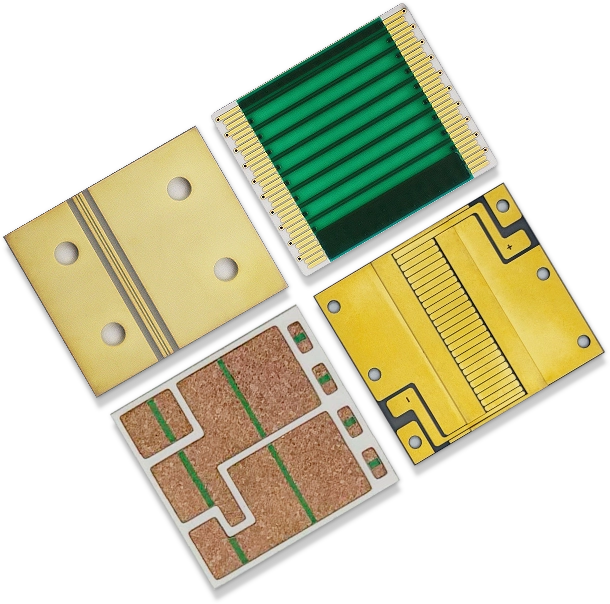 In terms of cost-effectiveness, the initial investment in Alumina & AlN Ceramic PCBs may be high. A standard 100mm x 100mm AlN substrate costs approximately $50-$100, which is 5-10 times that of an FR4 substrate. However, the long-term return is significant: in solar inverter applications, using AlN ceramic PCBs can reduce heat sink volume by 60% and increase overall system efficiency from 95% to 98%. This means that over a 10-year lifespan, energy savings can cover 200% of the initial cost. According to a report by market analysis firm Yole Développement, the high-power electronics market for ceramic PCBs is projected to grow at a CAGR of 12% by 2028, increasing its share from the current $1.5 billion to $3 billion, driven by expansion in the electric vehicle and renewable energy sectors. For example, Siemens' deployment of Alumina ceramic PCBs in wind turbine converters has extended maintenance cycles from 6 months to 2 years, reduced failure rates to 0.5%, and saved 20% on annual operating budgets.
Looking ahead, the integrated optimization strategy of Alumina & AlN ceramic PCBs is driving the evolution of high-power electronics towards greater compactness and efficiency. Their low thermal resistance characteristics, such as AlN's thermal resistance of less than 1°C/W, allow power devices to operate stably under 300A current loads with peak temperature fluctuations not exceeding ±5°C. In the aerospace field, Boeing's latest satellite power systems utilize this type of substrate, reducing weight by 30% while withstanding extreme temperatures from -200°C to 500°C, achieving a mission reliability probability of 99.9%. In terms of environmental protection, the ceramic materials have a recyclability rate of over 90%, reducing electronic waste and aligning with global carbon emission reduction targets. Through intelligent automated production, the manufacturing cycle is shortened to 3 days, with precision errors controlled within ±0.05mm, which inspires industry partners to accelerate innovation. In short, choosing Alumina & AlN Ceramic PCB is not only a technological upgrade but also a strategic investment; it is redefining the performance limits of high-power electronics and invites us to explore a more sustainable electronic future together.
In terms of cost-effectiveness, the initial investment in Alumina & AlN Ceramic PCBs may be high. A standard 100mm x 100mm AlN substrate costs approximately $50-$100, which is 5-10 times that of an FR4 substrate. However, the long-term return is significant: in solar inverter applications, using AlN ceramic PCBs can reduce heat sink volume by 60% and increase overall system efficiency from 95% to 98%. This means that over a 10-year lifespan, energy savings can cover 200% of the initial cost. According to a report by market analysis firm Yole Développement, the high-power electronics market for ceramic PCBs is projected to grow at a CAGR of 12% by 2028, increasing its share from the current $1.5 billion to $3 billion, driven by expansion in the electric vehicle and renewable energy sectors. For example, Siemens' deployment of Alumina ceramic PCBs in wind turbine converters has extended maintenance cycles from 6 months to 2 years, reduced failure rates to 0.5%, and saved 20% on annual operating budgets.
Looking ahead, the integrated optimization strategy of Alumina & AlN ceramic PCBs is driving the evolution of high-power electronics towards greater compactness and efficiency. Their low thermal resistance characteristics, such as AlN's thermal resistance of less than 1°C/W, allow power devices to operate stably under 300A current loads with peak temperature fluctuations not exceeding ±5°C. In the aerospace field, Boeing's latest satellite power systems utilize this type of substrate, reducing weight by 30% while withstanding extreme temperatures from -200°C to 500°C, achieving a mission reliability probability of 99.9%. In terms of environmental protection, the ceramic materials have a recyclability rate of over 90%, reducing electronic waste and aligning with global carbon emission reduction targets. Through intelligent automated production, the manufacturing cycle is shortened to 3 days, with precision errors controlled within ±0.05mm, which inspires industry partners to accelerate innovation. In short, choosing Alumina & AlN Ceramic PCB is not only a technological upgrade but also a strategic investment; it is redefining the performance limits of high-power electronics and invites us to explore a more sustainable electronic future together.
In terms of cost-effectiveness, the initial investment in Alumina & AlN Ceramic PCBs may be high. A standard 100mm x 100mm AlN substrate costs approximately $50-$100, which is 5-10 times that of an FR4 substrate. However, the long-term return is significant: in solar inverter applications, using AlN ceramic PCBs can reduce heat sink volume by 60% and increase overall system efficiency from 95% to 98%. This means that over a 10-year lifespan, energy savings can cover 200% of the initial cost. According to a report by market analysis firm Yole Développement, the high-power electronics market for ceramic PCBs is projected to grow at a CAGR of 12% by 2028, increasing its share from the current $1.5 billion to $3 billion, driven by expansion in the electric vehicle and renewable energy sectors. For example, Siemens' deployment of Alumina ceramic PCBs in wind turbine converters has extended maintenance cycles from 6 months to 2 years, reduced failure rates to 0.5%, and saved 20% on annual operating budgets.
Looking ahead, the integrated optimization strategy of Alumina & AlN ceramic PCBs is driving the evolution of high-power electronics towards greater compactness and efficiency. Their low thermal resistance characteristics, such as AlN's thermal resistance of less than 1°C/W, allow power devices to operate stably under 300A current loads with peak temperature fluctuations not exceeding ±5°C. In the aerospace field, Boeing's latest satellite power systems utilize this type of substrate, reducing weight by 30% while withstanding extreme temperatures from -200°C to 500°C, achieving a mission reliability probability of 99.9%. In terms of environmental protection, the ceramic materials have a recyclability rate of over 90%, reducing electronic waste and aligning with global carbon emission reduction targets. Through intelligent automated production, the manufacturing cycle is shortened to 3 days, with precision errors controlled within ±0.05mm, which inspires industry partners to accelerate innovation. In short, choosing Alumina & AlN Ceramic PCB is not only a technological upgrade but also a strategic investment; it is redefining the performance limits of high-power electronics and invites us to explore a more sustainable electronic future together.