How Does the Coospider UV Lamp Keep Your Air Clean?
UVC radiation with a wavelength of 254 nanometers has been proven to be a powerful tool for destroying the genetic material of microorganisms. Research data (such as the 2020 report of the National Institutes of Health (NIH) in the United States) indicate that UVC photons, under specific intensities (typically requiring an irradiation dose of ≥30,000 μJ/cm²), can penetrate the cell walls of bacteria, viruses, and mold spores, thereby inducing the formation of thymine dimers and rendering them unable to replicate. 99.99% of common air pathogens can be effectively inactivated within 1 to 30 seconds. Take the influenza virus as an example. A study in the journal Environmental Science & Technology in 2018 showed that continuous exposure to high-intensity UVC for 15 seconds could reduce the viral load by 99.9%. The ASHRAE Standard 241 (2023) of the United States has clearly incorporated UVC air disinfection into the core technical framework for controlling the spread of respiratory diseases, demonstrating its scientific reliability.
However, efficient air purification not only relies on the sterilization ability of UVC itself, but more importantly, on how to force the contaminated air to be fully exposed to the irradiation area. This requires a precise airflow system design. Modern professional equipment usually uses fans to drive air to flow through the UVC irradiation chamber. The air flow rate is strictly controlled within the range of 0.5 to 3 meters per second to ensure that microorganisms have sufficient residence time to receive effective dose irradiation. According to the standards of international certification bodies such as AHAM (Household Appliance Manufacturers Association of the United States), CADR (Clean Air Delivery Rate) is a key performance indicator. Taking a 20-square-meter room as an example, an air flow rate of 180 to 250 cubic meters per hour is required to ensure that the air can complete 5 to 6 air exchange cycles within one hour, significantly reducing the concentration of pathogens. Meanwhile, the system design must avoid the risk of secondary pollution. For instance, the coospider uv product may adopt a seamless all-metal air duct and a pre-filter configuration, with a physical interception efficiency of over 95% for large particles (such as PM10), preventing their accumulation and microbial growth outside the disinfection chamber.
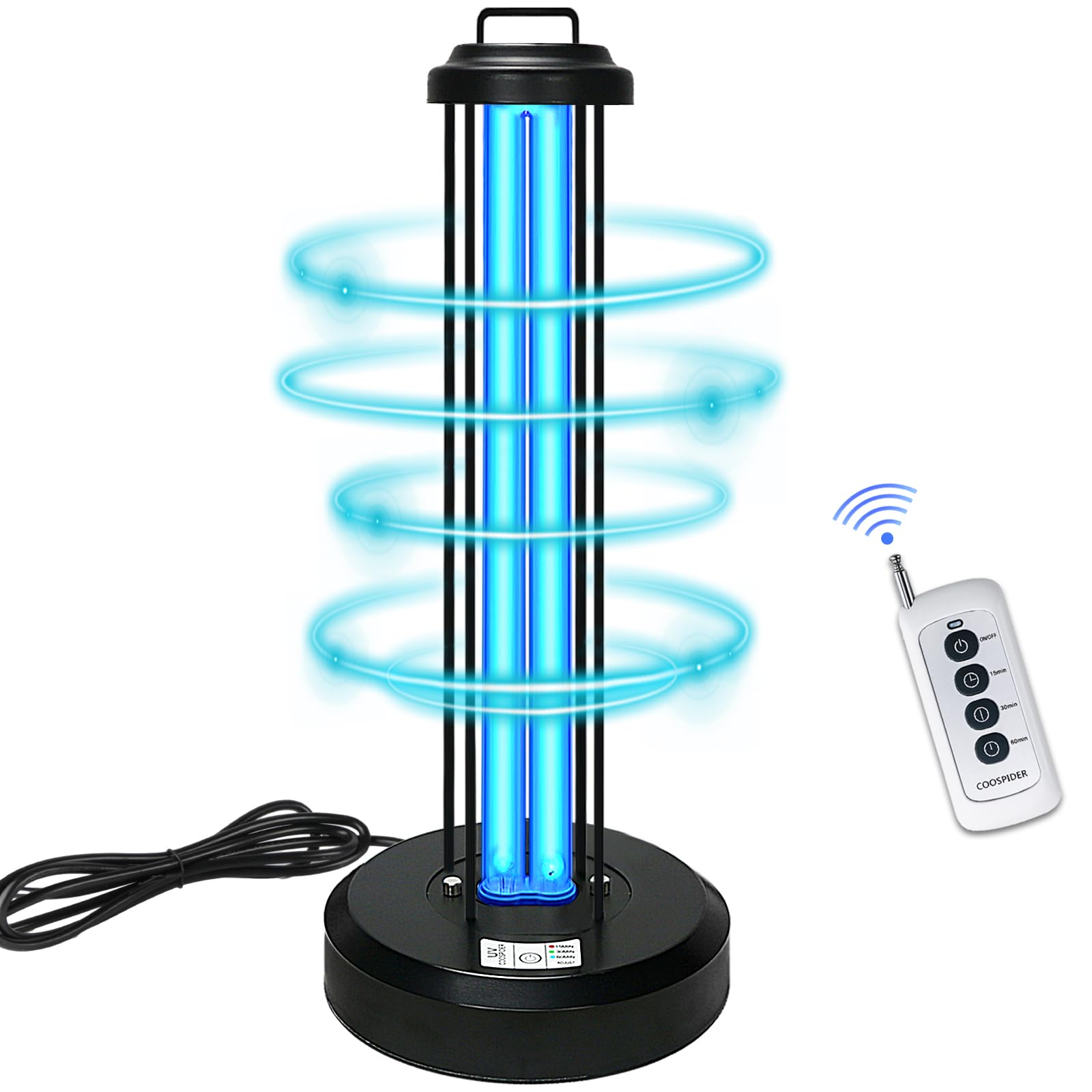 For home application scenarios, the device also needs to balance performance, security and noise control. A typical household UVC air purification device (with a volume of approximately 0.1 cubic meters) usually has a fan power ranging from 10 to 50 watts and uses a low-noise motor (≤45 decibels during operation, equivalent to a library environment). More importantly, there are multiple active safety guarantees: It must be equipped with a human infrared motion sensor to detect human activities within a range of 0.5 meters within 1 second and automatically turn off the UVC light source. The light sensor monitors the status of the UVC lamp tube in real time. When the cumulative lifespan exceeds 8,000 hours or the power output is lower than 75% of the rated value, it automatically alarms to prompt replacement. The concentration of ozone generation must be strictly controlled. According to the Chinese standard GB 21551.3-2010, it shall not exceed 0.05ppm to avoid secondary pollution. These measures are the basis of equipment reliability.
True performance verification relies on laboratory tests conducted by authoritative institutions in accordance with strict standards. For example, an independent test report for a specific model of coospider uv (such as in accordance with ISO 16890 or GB/T 18801 standards) shows that the purification efficiency (CADR) of this equipment for particulate matter with a particle size ≥0.3μm reaches 220 cubic meters per hour; For the H1N1 influenza virus suspended in the closed test chamber, an inactivation rate of 99.98% was achieved within 60 minutes. The average removal rate of natural colonies in the air was stably above 98.2% (with a 30-minute sampling period, determined by the Anderson impact method). Considering the limited penetration power of UVC, the device should be placed in the central position and kept running continuously (such as for 3 to 6 hours a day) to achieve the maximum effect. Combined with daily ventilation and regular cleaning, such equipment can effectively build a key technical defense line against airborne diseases.
For home application scenarios, the device also needs to balance performance, security and noise control. A typical household UVC air purification device (with a volume of approximately 0.1 cubic meters) usually has a fan power ranging from 10 to 50 watts and uses a low-noise motor (≤45 decibels during operation, equivalent to a library environment). More importantly, there are multiple active safety guarantees: It must be equipped with a human infrared motion sensor to detect human activities within a range of 0.5 meters within 1 second and automatically turn off the UVC light source. The light sensor monitors the status of the UVC lamp tube in real time. When the cumulative lifespan exceeds 8,000 hours or the power output is lower than 75% of the rated value, it automatically alarms to prompt replacement. The concentration of ozone generation must be strictly controlled. According to the Chinese standard GB 21551.3-2010, it shall not exceed 0.05ppm to avoid secondary pollution. These measures are the basis of equipment reliability.
True performance verification relies on laboratory tests conducted by authoritative institutions in accordance with strict standards. For example, an independent test report for a specific model of coospider uv (such as in accordance with ISO 16890 or GB/T 18801 standards) shows that the purification efficiency (CADR) of this equipment for particulate matter with a particle size ≥0.3μm reaches 220 cubic meters per hour; For the H1N1 influenza virus suspended in the closed test chamber, an inactivation rate of 99.98% was achieved within 60 minutes. The average removal rate of natural colonies in the air was stably above 98.2% (with a 30-minute sampling period, determined by the Anderson impact method). Considering the limited penetration power of UVC, the device should be placed in the central position and kept running continuously (such as for 3 to 6 hours a day) to achieve the maximum effect. Combined with daily ventilation and regular cleaning, such equipment can effectively build a key technical defense line against airborne diseases.
For home application scenarios, the device also needs to balance performance, security and noise control. A typical household UVC air purification device (with a volume of approximately 0.1 cubic meters) usually has a fan power ranging from 10 to 50 watts and uses a low-noise motor (≤45 decibels during operation, equivalent to a library environment). More importantly, there are multiple active safety guarantees: It must be equipped with a human infrared motion sensor to detect human activities within a range of 0.5 meters within 1 second and automatically turn off the UVC light source. The light sensor monitors the status of the UVC lamp tube in real time. When the cumulative lifespan exceeds 8,000 hours or the power output is lower than 75% of the rated value, it automatically alarms to prompt replacement. The concentration of ozone generation must be strictly controlled. According to the Chinese standard GB 21551.3-2010, it shall not exceed 0.05ppm to avoid secondary pollution. These measures are the basis of equipment reliability.
True performance verification relies on laboratory tests conducted by authoritative institutions in accordance with strict standards. For example, an independent test report for a specific model of coospider uv (such as in accordance with ISO 16890 or GB/T 18801 standards) shows that the purification efficiency (CADR) of this equipment for particulate matter with a particle size ≥0.3μm reaches 220 cubic meters per hour; For the H1N1 influenza virus suspended in the closed test chamber, an inactivation rate of 99.98% was achieved within 60 minutes. The average removal rate of natural colonies in the air was stably above 98.2% (with a 30-minute sampling period, determined by the Anderson impact method). Considering the limited penetration power of UVC, the device should be placed in the central position and kept running continuously (such as for 3 to 6 hours a day) to achieve the maximum effect. Combined with daily ventilation and regular cleaning, such equipment can effectively build a key technical defense line against airborne diseases.